
Donkey's Edge

Texas Hold'em range intelligence

See the range. Find the edge.

Visualize how your hand performs against every possible opponent holding—or narrow the grid to the range they actually play.

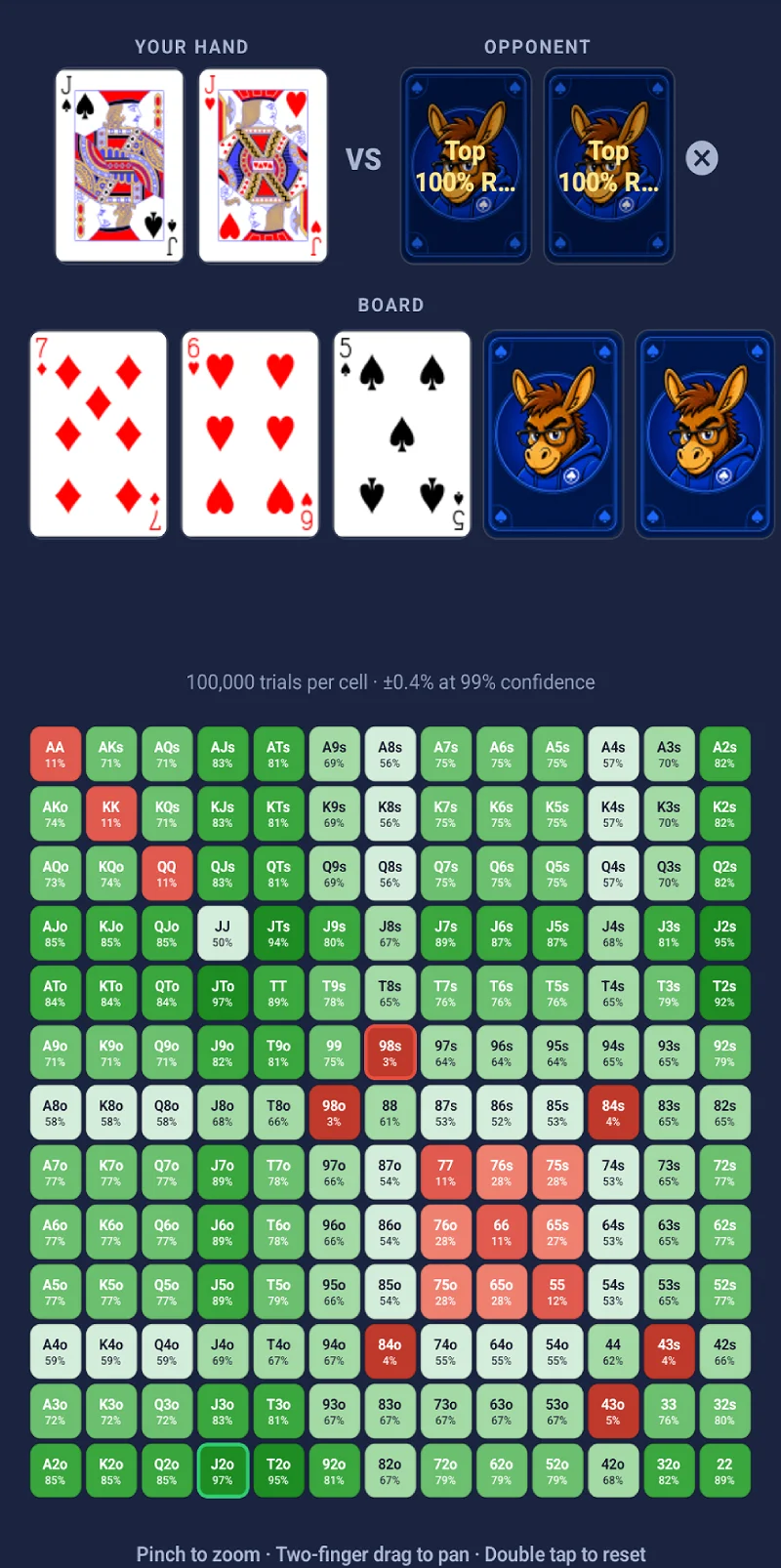
A real table question: You hold JJ on 7-6-5. Which part of a loose caller's range are you actually ahead of?

Donkey's Edge Range Analysis screen showing cards and the 13 by 13 equity matrix
Actual app view
169 starting handsThe complete Hold'em matrix
100,000 trialsSimulated for every cell
99% confidenceAbout ±0.4% near 50% equity
Custom rangesAnalyze who they actually are

From cards to clarity

A full range, made readable

Build the spot, run the analysis, and see where your hand is strong or vulnerable without decoding a wall of numbers.

01 · DEFINE

Recreate the decision you actually faced.

Choose your two hole cards, add any known flop, turn, or river cards, and set the opponent range. Analyze every possible holding or focus on a realistic slice.

  • Hero hole-card selection
  • Optional flop, turn, and river cards
  • Full-grid or custom opponent range
  • Dimmed cells identify excluded hands
Hero
J♠ J♥
Locked
Board
7♦ 6♥ 5♠
Flop
Opponent range
Selected starting hands
Custom

02 · SIMULATE

Test the hand against every matchup.

Donkey's Edge runs Monte Carlo simulations across the matrix, evaluating your hand against each opponent starting hand that can legally remain.

  • 100,000 simulation trials per cell
  • All 169 pair, suited, and offsuit classes
  • Blocked combinations handled by the actual cards
  • High-confidence equity estimates
Complete Donkey's Edge Hold'em equity heat map

03 · READ

Spot the pattern before you study the percentage.

The color tells the story first. Green identifies favorable matchups, red exposes the hands that have you in trouble, and neutral cells mark the close decisions.

  • Pairs run down the diagonal
  • Suited hands sit above the diagonal
  • Offsuit hands sit below the diagonal
  • Every cell includes its equity estimate
High equity
You are ahead
Green
Close matchup
The decision is thin
Neutral
Low equity
You are behind
Red

Study better

Turn a hand history into a reusable lesson

See the whole range

One matrix replaces 169 disconnected calculations and makes the shape of the matchup obvious.

Model the real opponent

Narrow the range to match a tight opener, loose caller, or any player profile you are studying.

Connect reads to math

Pair a Player Notes tendency with the heat map to see how the adjustment changes your equity.

Stop studying one hand at a time.

See the complete matchup, understand the pattern, and take a clearer decision back to the table.

Explore Range Analysis in Donkey's Edge